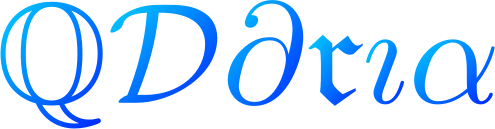
Rₖ(θ) = exp(−iθσₖ/2); CP(θ) = diag(1, 1, 1, eⁱᶿ); CZ = CP(π).
Assumptions and limits
- Ideal one- or two-qubit pure-state model. The remaining nodes show connectivity only; there is no 108-qubit state simulation, leakage, crosstalk, noise or calibrated pulse simulation.
- Schematic distances and chiplet gaps have no physical length unit. A node represents a programmable qubit; a line represents a connection. Heavy-lattice midpoint nodes are qubits.
- Cepheus topology is transcribed from the user-supplied 108Q Spec Sheet - April 2026.pdf, page 3: row-major qubits 0–107, 195 connections. Page 1 reports 216 tunable couplers. No missing edges are invented and no live device map is claimed.
- The supplied PDF reports median RX/RY duration 40 ns, CZ 60 ns, T1 25 µs and T2 10 µs. Its separate isolated and simultaneous errors are not used in this ideal model. Animation speed is unrelated to device gate time.
- Continuous RX/RY angles and CP(θ) are mathematical controls. The April native RX/RY angles are π and ±π/2; general rotations require synthesis. RZ is a virtual phase update. H denotes an ideal basis change.
- Comparison patches differ in size and boundary shape; their graph statistics alone do not rank processor performance. Heavy-square is a research construction, not a claim about a current IBM QPU.
Sources · 6 references