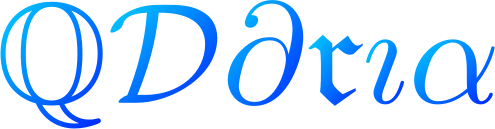
F and R moves
Fusion trees for three τ anyons with total charge τ come in two bases, and the F move relates them. Every other admissible F-symbol equals 1 in this gauge, and the two R phases are the counter-clockwise exchange eigenvalues in the two fusion channels.
Explicit R and F in this convention: Hormozi et al. 2007 [5], Eqs. 5 and 6; the same generators are drawn in Bonesteel et al. 2005 [3]. Trebst et al. 2008 [6] use the complex-conjugate convention, the mirror-image theory. Ribbon relation: Kitaev 2006 [14].
Pentagon and hexagon
Consistency of the F moves on four anyons is the pentagon equation; consistency of R with F is the hexagon equation. With the convention |((ab)e c)d⟩ = Σf [Fabcd]ef |(a (bc)f)d⟩ they read
For τ × τ = 1 + τ the pentagon with unitarity fixes Fττττ up to phases, and the hexagon then leaves exactly two solutions for R, complex conjugates of each other; the choice is the chirality of the theory. The test suite behind this page checks both equations numerically over all label assignments for the F and R above, and checks that a shifted R phase breaks the hexagon.
Kitaev 2006 [14], Appendix E; Nayak et al. 2008 [4], Sec. III; Hormozi et al. 2007 [5]; Trebst et al. 2008 [6], Secs. 2.4 and 2.5.
Braid-group representation and density
B₃ acts on the two-dimensional fusion space through σ₁ = diag(R1, Rτ) and σ₂ = Fσ₁F, which satisfy σ₁σ₂σ₁ = σ₂σ₁σ₂. Freedman, Larsen and Wang proved that for the Jones representation at a fifth root of unity, which is this model, the closure of the image of Bn contains SU of each irreducible sector for n ≥ 3, so the image of B₃ is dense in PU(2) and every single-qubit gate is approximable by a three-strand braid; with more strands the representation is universal for quantum computation. In the four-anyon encoding B₄ acts on the same space with σ₃ = σ₁, so the image is unchanged. With five anyons at charge τ, B₅ acts irreducibly on the five-dimensional space F₅ = 5 through the generators shown in the Model section.
Compiling: brute-force search over braids of up to 46 crossings reaches ε of order 10−3 in operator-norm distance, and Solovay–Kitaev iteration lengthens the braid as |log ε|c with c ≈ 4 [3]; a 44-crossing weave for iX reaches ε ≈ 8.5 × 10⁻⁴ and one Solovay–Kitaev step ε ≈ 4.2 × 10⁻⁵ [5]; asymptotically optimal synthesis reaches depth O(log 1/ε) with a probabilistically polynomial-time algorithm [16]. The exhaustive compiler above stops at 14 crossings, which is why its errors stay at a few times 10−3.
Freedman, Larsen, Wang 2002 [2, 15]; Bonesteel et al. 2005 [3]; Hormozi et al. 2007 [5]; Kliuchnikov, Bocharov, Svore 2014 [16].
Leakage in two-qubit braids
Braiding an anyon from one qubit through another leaves the computational subspace in general: the pair of triples has a larger fusion space than two qubits. Bonesteel et al. avoid this with an injection weave that moves a pair of anyons as a unit through the second qubit and back, so the braid stays inside a total-charge eigenstate; in the limit of an exact injection weave there is no leakage. Their controlled-NOT has ε ≈ 1.8 × 10⁻³ and 1.2 × 10⁻³ for total charge 1 and τ of the six anyons, with the injection weave itself at ε ≈ 1.5 × 10⁻³ [3]. Hormozi et al. give the general construction and show that leakage can be reduced to zero in the limit ε → 0 [5].
Error correction and the threshold
The Fibonacci Turaev–Viro code, the string-net code whose anyons are Fibonacci anyons, has a code-capacity threshold of 4.7 % for fixed-rate sampling depolarizing noise with a clustering decoder and 7.3 % for pure dephasing, with perfect measurements [7]. Dauphinais and Poulin proved that a fault-tolerance threshold exists for a class of non-cyclic anyon models with noisy measurements and simulated Ising anyons, finding a threshold between 10−4 and 10−3 [8]; the Fibonacci numbers quoted here come from the Turaev–Viro code numerics.
Encodings
Three τ anyons with total charge τ form the minimal Fibonacci qubit used in the compiling literature [3, 5]; the third state of the triple, with total charge 1, is non-computational and decoupled. Four τ anyons with total charge 1 span the same two-dimensional space (F₃ = 2), the pair basis |((ττ)a (ττ)a)1⟩ coincides with the three-anyon basis, and the charge-neutral form is the one drawn in interferometry and readout schemes [4]. Two anyons at fixed total charge span one state, so a single pair is not a qubit. Five τ anyons at charge τ span F₅ = 5 states: the full fusion space, shown here with all four generators, not a qubit.